moma Challenges Definition of Drawing


NEW YORK, NY.- On Line: Drawing Through the Twentieth Century, on view at MoMA from November 21, 2010, through February 7, 2011, aims to challenge the conventional definition of drawing as a work on paper by exploring the radical transformation of the medium throughout the last century, a period when numerous artists critically examined the traditional concepts of drawing and expanded its definition in relation to gesture and form. The exhibition brings together approximately 300 works, many drawn from MoMA’s collection, by over 100 artists—both canonical and less well-known—from over 20 nations. Crossing disciplinary boundaries, these works relate drawing to selections of painting, sculpture, photography, film, and dance (represented by films and documentation, as well as live performances). The exhibition is organized by Connie Butler, The Robert Lehman Foundation Chief Curator of Drawings, The Museum of Modern Art, and Guest Curator Catherine de Zegher, former Director, The Drawing Center, New York (recently appointed as Co-Director of the 18th Biennale of Sydney).

http://www.artdaily.org/index.asp?int_sec=2&int_new=42724

http://www.moma.org/interactives/exhibitions/2010/online/#introduction

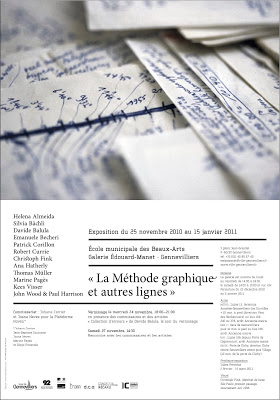
La Méthode graphique et autres lignes


http://rovenrevue.blogspot.com


Ecole municipale des beaux-arts Galerie Edouard-Manet de Gennevilliers

La Méthode graphique et autres lignes

Commissariat : Johana Carrier et Joana Neves pour la Plateforme Roven

25 novembre 2010-15 janvier 2011

------------------------------------------

Exposition du jeudi 25 novembre 2010 au samedi 15 janvier 2011

Vernissage en présence des commissaires et des artistes + « Collection d’erreurs », perfor- mance de Davide Balula → mercredi 24 novembre [18:00—21:00]

Rencontre avec les commissaires et les artistes → samedi 27 novembre [14:30—16:00]


https://static1.squarespace.com/static/53393d65e4b0753aa3c845af/55fef69fe4b09d8d9e7d4efa/55fef6a7e4b09d8d9e7d58b2/1442772647640/1000w/
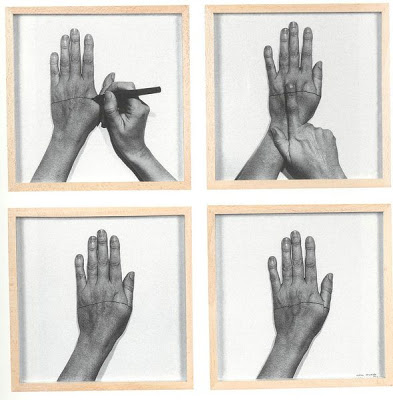
Helena Almeida

http://www.houseanduniverse.com/storage/bachli2.jpg?__SQUARESPACE_CACHEVERSION=1285252853503
Silvia Bächli

http://images.artnet.com/artwork_images/424301146/572427.jpg
Emanuele Becheri
Robert Currie


Christoph Fink
http://www.drawingcenter.org/images/artwork/large/Sel_Portugal4.jpg
Ana Hatherly

http://www.art-karlsruhe.de/typo3temp/pics/5f9172e7ed.png
Thomas Müller

https://static1.squarespace.com/static/53393d65e4b0753aa3c845af/55fef69fe4b09d8d9e7d4efa/55fef6a7e4b09d8d9e7d58b3/1442772647640/1000w/
Marine Pagès

http://www.lille.sortir.eu/expos/perspectives-geometriques/visser-3.jpg/image
Kees Visser

et
John Wood
Paul Harrison
Davide Balula
Patrick Corillon

------------------------------------------

Communiqué de presse
Issue de la science expérimentale du xixe siècle, l’expression « méthode graphique » désigne le développement de procédés de traduction et de quantification des mouvements de la matière et des organismes. Nulle autre innovation technique n’a fait vibrer la frontière entre science et esthétique de façon aussi intense et durable. « C’est l’impression d’assister à de la pure beauté en train de se faire, de se défaire, de se refaire incessamment sous nos yeux » écrit Georges Didi-Huberman à propos des photographies de fluides d’Etienne-Jules Marey, adepte de la mé- thode ; il ajoute, avec une certitude déconcertante : « inutile d’essayer d’y résister* ». Un siècle plus tard, dans le film American Beauty**, l’appropriation collective d’une esthétique touchée par le mouvement du réel est célébrée par la danse aérienne d’un sac en plastique filmée par un adolescent.
En tant que technique, la « méthode graphique » est directement issue de l’invention d’appa- reils de mesure de ce mouvement. Afin de mieux étudier les flux de la nature, le scientifique essaye de les quantifier. C’est ainsi que, sur un rouleau mobile de papier millimétré, s’inscri- vent, sous forme de lignes, les pulsations de la matière. Il est désormais possible de « transcrire sur papier ou sur une surface sensible, par des mécanismes souvent d’une grande ingéniosité, les pulsations, vibrations, ondulations, secousses, tressaillements, frémissements, produits par tous les mouvements de tous les corps vivants ou des objets mobiles*** » : ainsi surgissent les appareils enregistreurs tels que les cardiographes (pour le cœur), les anémomètres (pour le vent), les sphygmomètres (pour le pouls), etc. Des trajectoires précises peuvent en outre être dessinées grâce à la chronophotographie.
Ces techniques d’auscultation de la matière produisent des tracés d’une étrange beauté, direc- tement indexés à la vie. Leur intérêt scientifique s’étend et se développe jusqu’à aujourd’hui : des diagrammes de toutes sortes ont envahi l’imaginaire commun. La ligne tracée par la ma- chine ou par transposition peut être assimilée au trait du dessin artistique - elle y introduit, d’ailleurs, le geste de la main (assistée parfois par la machine), ses hésitations, ses recommen- cements, ses répétitions. Cet avènement d’une ligne sensible au détriment d’une ligne mimé- tique concerne la plupart des œuvres réunies dans l’exposition. D’autres mettent en exergue le caractère expérimental**** de l’enregistrement et de la mesure des phénomènes dans des fictions pleines d’humour.
Cette relation entre le phénomène et sa traduction linéaire détermine ainsi de nouveaux terri- toires de travail pour l’artiste. Le statut et la fonction du dessin comprennent désormais le dé- placement du corps et le mouvement de la matière, leur relation renouvelle ainsi la conception de l’espace et du temps. Ce processus, inauguré par les 3 Stoppages étalon de Marcel Duchamp, s’enracine dans une redéfinition du graphique dans l’art à travers ses outils, sa conception de la trace et sa pensée du mouvement. La représentation du corps et des phénomènes en général est à son tour aſſectée par cette vision. Le corps est interprété comme un cumul de mouve-
ments organiques et mentaux qui peuvent être exprimés tantôt par des diagrammes, tantôt par des sondages d’opinion. Le schéma mental ou simplement idiosyncratique fait son apparition lorsque l’œuvre graphique traduit un parcours imaginaire ou réel du corps, du regard ou de l’écriture de l’artiste. La représentation devient transposition sous forme de cartes, de découpes ou encore de démonstrations.
Dès le surgissement de cette rigueur mathématique appliquée aux phénomènes, une réaction artistique se fait sentir, celle d’une dérision fascinée, d’un détournement existentiel et poétique à la fois littéral et latéral. Les artistes réunis ici autour de ce champ thématique sont les héritiers obliques de telles pratiques scientifiques mais aussi de la tradition esthétique qui en prit acte. Les œuvres exposées reprennent le langage de la ligne, de la trace, de la transposition et de la traduction de la matière en mouvement. Le corps de l’artiste ou du spectateur se trouve placé au sein de l’expérience comme s’il était lui-même cet instrument traceur de lignes et étalon de mesure. Tout en s’en inspirant, l’observation de l’artiste est détournée de la précision graphique pour mesurer les conséquences du développement d’un langage diagrammatique. Une beauté abstraite s’en dégage - et une suggestion de l’abstraction comme trace -, ainsi qu’un comique propre à toute mécanique appliquée au corps.
Johana Carrier et Joana Neves, commissaires de l’exposition

Monika Grzymala

http://tlktlk.com/redev/wp-content/uploads/2009/02/thedrawingroom-1.jpg

http://mojix.org/photo/20091207-grzymala2.jpg
https://static1.squarespace.com/static/53393d65e4b0753aa3c845af/55fef69fe4b09d8d9e7d4efa/55fef6a7e4b09d8d9e7d58bf/1442772647789/1000w/
http://viewoncanadianart.com/wp-content/uploads/2008/01/grzymala-03.jpg

https://static1.squarespace.com/static/53393d65e4b0753aa3c845af/55fef69fe4b09d8d9e7d4efa/55fef6a7e4b09d8d9e7d58c0/1442772647790/1000w/


great talk in the drawing room:
http://www.drawingroom.org.uk/education/talks.htm
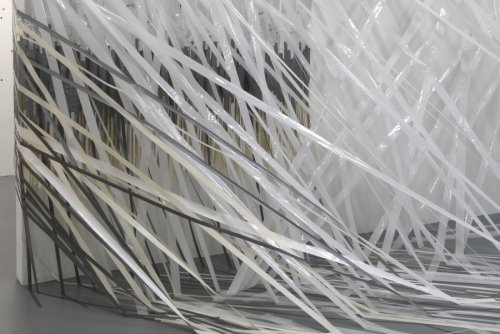
Grzymala is a Polish-born artist who's lived in Germany for many years, primarily in Hamburg and now Berlin. She makes installations that might be described as a kind of three-dimensional drawing, and her signature material is tape, tape of all colors and kinds: packing, masking, adhesive, upholstery, etc.
Grzymala studied art at several universities in Germany. During her time in school, she mostly made sculpture. When a professor suggested that her interest seemed to be in the relationship between objects, not in the objects themselves, the nature of her work changed. She stopped making sculpture and focused on drawing, exploring the basics of line and mark. Eventually, to borrow Paul Klee's phrase, Grzymala's line went out for a walk–her drawings moved off the page and into space. She started using tape to draw in–draw on–a room. Walls, floors, ceilings, and the space between them became her canvas or page.
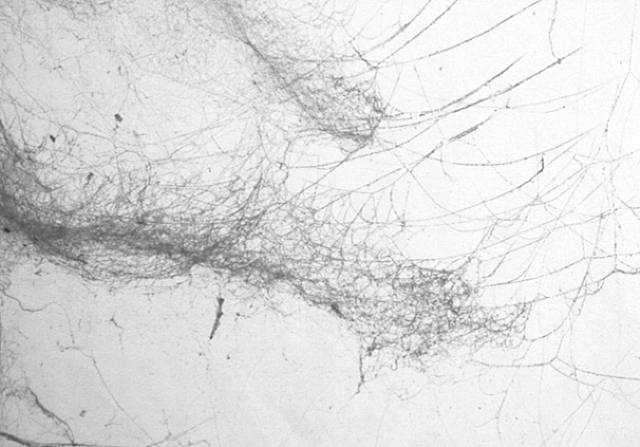
Grzymala has made her tape installations at many different venues in Europe and the U.S. Each work is site-specific–created in response to the conditions and configuration of a given space. In Transition, a work created for the 2005 group show Freeing the Line at Marian Goodman in New York, black tape seemed to hurtle laterally across the gallery walls, turn corners, then leap off the wall to wrap around a pillar. In 2006, for a piece at the Center for Experimental Art in Islip, New York, Grzymala suspended furniture and the remains of a previous exhibition in a dense web of transparent packing tape.
Sometimes the artist will use paint instead of tape. In 2000, for example, she created a giant painting on the surface of a skating rink in Hamburg. Skaters skated on the painting for one night, then the freezer unit was turned off and the painting slowly melted. In 2001-02, Grzymala was invited by a retirement-insurance company to create a permanent installation for an office building in Hamburg. The resulting work, Medulla Spinalis, treated the building's elevator shaft as though it were a spinal cord of sorts: skeins of acrylic paint, thicker and darker at ground level, lighter and thinner on higher floors, radiated out from the central shaft and circulated through the building.
For her show at the Locker Plant, Grzymala used tape, paint, and an assortment of dead trees she collected around Marfa. The trees, leafless and stark, reminded the artist of drawings; incorporating them into a show allowed her to expand her method of drawing in space. The trees were broken up and placed in a kind of semi-circle occupying most of in the Locker Plant's front room. At the back of the room, unpainted tree fragments were lashed densely together with brownish or "tree-colored" tape. To the east, they were painted a range of pale greys, browns, and silvers, and assembled more loosely with similarly-colored tape. Starting in the room's center and moving to the west, the branches became more and more brightly hued. This room-wide movement through color reached a crescendo with the branches rearing up against the front window to the west: here, on both tree limbs and tape, was a range of super-saturated yellows, oranges, pinks, purples, blues, and greens.
Scattered on the floor were small scraps of colored paper–Grzymala's "leaves." Their color trajectory generally corresponded to the one visible in the trees, but the palette was more mixed, and visitor movements and random breezes caused the colors to keep on mixing. This gave the installation a sense of transitoriness, of flux. Though built of dead trees, Grzymala's arboretum changed on a daily basis.
Monika Grzymala was born in Zabrze, Poland in 1970. She moved to Germany with her family in 1980. She studied stone sculpture and restoration in Kaiserlautern from 1990 to 1994 and in 2001 earned a degree in fine art from the Hochschule für Bildende Künste in Hamburg. She is currently working on a permanent installation for the Dian Woodner collection in New York, and in 2008-09 will create new site-specific works for the Hayward Gallery, the Drawing Room, and other venues in the United Kingdom

Issam Abu-Shakra


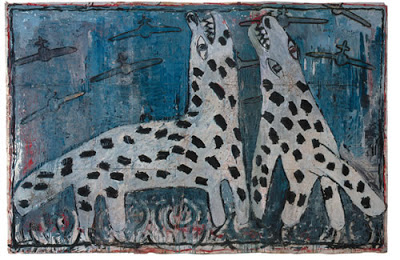
Abu Shakra, Issam, Israel, 1961-1990
Assam Abu Shakra, Painter. b. 1961, Um el Fachm. Studies: 1982-86 Kalisher School, Tel Aviv. Teaching: Kalisher School. Prizes: 1983-84 Scholarship from Kalisher School; 1989 America-Israel Cultural Foundation. Died 1990. His cousins, Walid, Said and Farid Abu Shakra made a memorial exhibition of his works at Efrat Gallery, Tel Aviv.


Two dappled animals howl at the heavens at night. Two mythological animals, possibly predators, act out an erotic mating ritual, hark their yowling, when it combines with the roar of a formation of jet fighters passing overhead. Archaic nature and modernistic technology coalesce into a new nature, paradoxical and insufferable. The monumentality of the two primeval creatures, ruling in format to its furthermost reaches – from earth to heavens and from side to side – respond in miniature to the mechanical “birds” on their way to propagate death. A neo-expressionist picture of a young artist, an Israeli Arab, who translates, in the 1980's, the realism of warfare into natural, gruesomely timeless pictures. Here, the erotic mating ritual is doomed to failure. In the tension between sex and death, victory is reserved for death; and in a primeval and primitive world, where the heavens were intended for migratory birds, military-technological man forced his hostile terrorist reign on the heavens. Pastoralities of animalism thus cipher devastation; nature doomed to destruction, Eros to extermination. Proliferation and reproduction apply henceforth only to the swarm of bombers. The saga of raw and healthy nature that evolved into a civilization riddled with aggression. Assam Abu Shakra views the aggressive culture of his time and place as an accursed mutation of power-oriented nature.
Dr. Gideon Ofrat